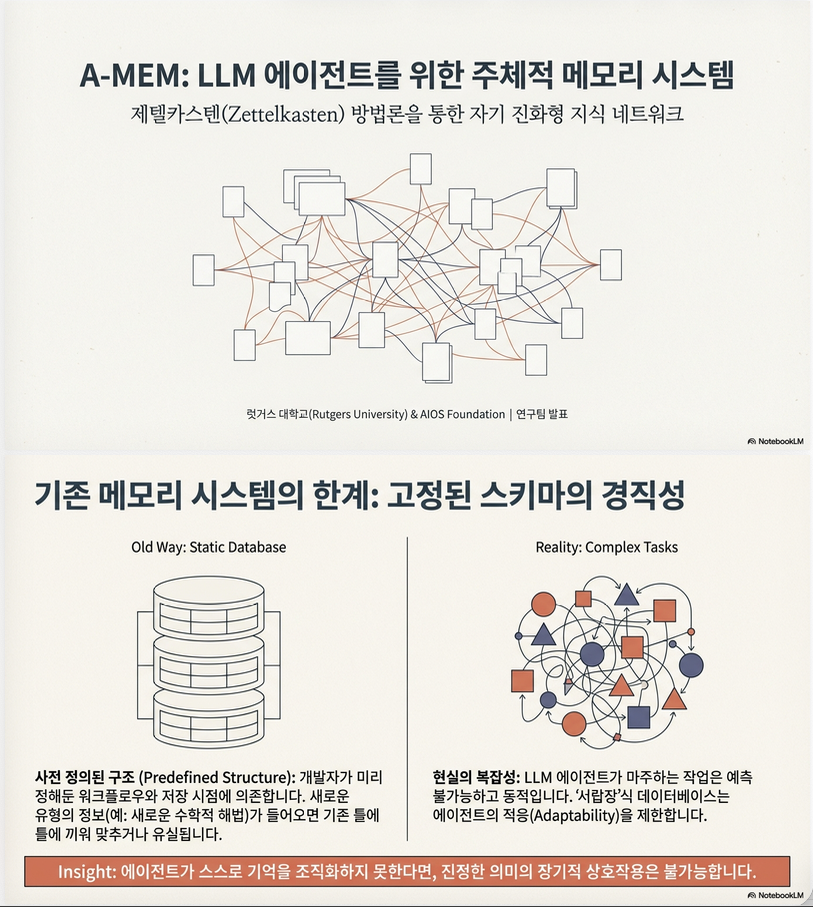
1. 문제 정의 (Why?)
LLM agent는 tool 사용 + reasoning은 강하지만:
기존 memory 시스템의 한계
- 정적 구조 (static schema)
- workflow에 memory write/read 시점이 미리 정의됨
- graph DB도 schema 고정 → 새로운 관계 생성 어려움
- long-term interaction에서 generalization 부족
핵심 문제:
“LLM agent가 경험을 통해 지식 구조 자체를 진화시키지 못한다”
2. 핵심 아이디어: Agentic Memory
기존 vs A-MEM
| 구분 | 기존 Memory | A-MEM |
|---|---|---|
| 구조 | static | dynamic |
| link 생성 | predefined | LLM이 생성 |
| 업데이트 | 없음 | memory evolution |
| 역할 | storage | self-organizing knowledge system |
핵심 컨셉:
memory도 agent처럼 능동적으로 조직되고 진화해야 한다
3. 방법론 (핵심 구조)
A-MEM은 Zettelkasten 방식 + LLM agentization 결합
3.1 Note Construction (memory representation)
각 memory는 단순 텍스트가 아니라 structured note:
- c_i: 원본 interaction
- t_i: timestamp
- K_i: keywords (LLM 생성)
- G_i: tags (LLM 생성)
- X_i: contextual description (핵심)
- e_i: embedding
- L_i: links
특징:
- multi-view semantic representation
- symbolic + embedding hybrid
3.2 Link Generation (핵심 기여 1)
Step 1: similarity retrieval
Top-k memory 선택
Step 2: LLM 기반 관계 생성
중요 포인트:
- 단순 cosine similarity가 아니라
- LLM이 관계 의미를 해석해서 link 생성
즉:
similarity → candidate
LLM → semantic relation 판단
3.3 Memory Evolution (핵심 기여 2)
새로운 memory가 들어오면 기존 memory를 업데이트:
업데이트 대상:
- context description
- keywords
- tags
핵심:
memory는 static DB가 아니라 continual learning system
3.4 Retrieval
- query embedding 기반 top-k retrieval
- 이후 LLM reasoning에 context로 사용
4. 핵심 차별점 (중요)
기존 RAG vs A-MEM
| 구분 | Agentic RAG | A-MEM |
|---|---|---|
| retrieval | dynamic | dynamic |
| storage | static | dynamic |
| knowledge evolution | 없음 | 있음 |
논문 핵심 주장:
기존 agentic RAG는 retrieval만 agentic
A-MEM은 memory 자체가 agentic
5. 실험 결과 (핵심 해석)
5.1 성능 (LoCoMo dataset)
- multi-hop reasoning에서 압도적 향상
- GPT / Qwen / Llama 모두 일관된 개선
특히:
- Multi-hop F1:
- 기존 대비 2배 이상 향상
이유:
- memory 간 연결 구조 → reasoning chain 형성
5.2 Efficiency
- Token usage:
- 기존: ~16,900 tokens
- A-MEM: 1,2002,500 tokens
의미:
compressed but structured memory
5.3 Ablation (중요 insight)
| 설정 | 성능 |
|---|---|
| w/o LG & ME | 크게 하락 |
| w/o ME | 중간 |
| full (A-MEM) | 최고 |
해석:
- Link Generation = 필수
- Memory Evolution = refinement
5.4 Hyperparameter (k)
- k ↑ → 성능 증가
- 하지만:
- 일정 이상 → plateau or 감소
trade-off:
context richness vs noise
5.5 Memory structure 분석 (t-SNE)
- A-MEM → clustered structure
- baseline → dispersed
의미:
memory가 실제로 지식 구조를 형성함
6. 핵심 기여 정리
(1) Agentic Memory 개념 제안
- memory 자체를 agent화
(2) Link Generation
- LLM 기반 semantic linking
(3) Memory Evolution
- 지속적 knowledge refinement
(4) Zettelkasten + LLM 결합
- atomic note + graph-like structure
7. 한계
논문에서 명시:
- LLM 품질에 의존
- link / context 생성 variability
- multimodal 확장 미지원
8. 한 줄 요약
A-MEM은 LLM agent의 memory를 단순 저장소가 아니라 LLM이 스스로 조직하고 진화시키는 agentic knowledge graph로 만든 시스템이다.
2. Related Work
2.1 Memory for LLM Agents
(1) 기존 접근 방식 분류
논문은 기존 memory 시스템을 다음과 같이 구조적으로 분류합니다:
(A) Full Interaction Storage / Dense Retrieval
- 모든 interaction을 저장
- embedding 기반 retrieval
대표:
- dense retrieval memory
- read-write memory 구조
특징:
- long-term 기록 유지 가능
- 하지만:
- 구조 없음
- 의미적 관계 부족
(B) Cache / Hierarchical Memory (MemGPT 계열)
- recent memory vs long-term memory 분리
- OS memory 구조와 유사
대표:
- MemGPT
특징:
- context window 문제 해결
- priority-based memory 관리
한계:
- 구조적 지식 형성 없음
- memory 간 관계 없음
(C) Controller-based Memory
- memory stream + controller
대표:
- SCM (Self-Controlled Memory)
특징:
- memory 유지/삭제를 정책적으로 관리
한계:
- 여전히 predefined rule 기반
(D) Structured Memory / Graph 기반
대표:
- Mem0 (RAG + graph DB)
특징:
- 구조적 memory organization
- node/edge 기반 관계
핵심 한계:
graph schema가 고정됨
→ 새로운 관계 생성 불가
→ generalization 제한
(2) 공통적인 근본 한계
논문이 강조하는 핵심 문제:
1. Predefined memory operation
- 언제 write / retrieve 할지 고정
2. Static structure
- schema 또는 구조가 고정됨
3. Lack of adaptability
- 새로운 개념 등장 시 구조 확장 어려움
4. Weak long-term generalization
요약:
기존 memory 시스템은
“저장 + 검색”은 가능하지만
지식 구조를 스스로 발전시키지 못함
(3) 본 논문의 포지셔닝
A-MEM은 위 한계를 다음으로 해결:
- memory write → LLM이 생성
- memory link → LLM이 생성
- memory update → LLM이 수행
즉:
memory 자체를 agent화 (agentic memory)
2.2 Retrieval-Augmented Generation (RAG)
(1) Standard RAG
구조:
- document chunking
- embedding indexing
- query → retrieval
- prompt에 삽입
장점:
- external knowledge 활용
- hallucination 감소
한계:
- knowledge base는 정적
(2) Advanced RAG
확장된 기능:
- pre-retrieval optimization
- post-retrieval filtering
- reranking
(3) Agentic RAG
최근 발전 방향:
- 언제 retrieval할지 결정
- 무엇을 retrieval할지 결정
- iterative retrieval
- self-reflection 기반 검색
핵심:
retrieval process는 agentic
(4) 한계 (논문 핵심 주장)
Agentic RAG조차도:
knowledge base는 여전히 static
- memory 자체는 변하지 않음
- 관계 구조 고정
즉:
“retrieval만 똑똑해졌을 뿐
knowledge는 진화하지 않는다”
(5) A-MEM과의 본질적 차이
논문에서 가장 중요한 비교:
| 구분 | Agentic RAG | A-MEM |
|---|---|---|
| retrieval | dynamic | dynamic |
| memory structure | static | dynamic |
| knowledge evolution | 없음 | 있음 |
핵심 문장:
A-MEM은 retrieval이 아니라
memory structure 자체에 agency를 부여한다
3. Related Work 전체 요약
핵심 흐름
기존 Memory → 구조 없음
↓
Graph Memory → 구조 있지만 고정됨
↓
Agentic RAG → retrieval만 agentic
↓
A-MEM → memory 자체가 agentic
3. Methodology: A-MEM
전체 구조 요약
A-MEM은 4단계 pipeline으로 구성됩니다:
Interaction → Note Construction → Link Generation → Memory Evolution → Retrieval핵심 특징:
- memory 생성: LLM
- memory 연결: LLM
- memory 업데이트: LLM
3.1 Note Construction (Memory Representation)
(1) Memory 정의
각 memory는 다음과 같은 structured note:
구성 요소:
| 구성 | 의미 |
|---|---|
| c_i | 원본 interaction |
| t_i | timestamp |
| K_i | keywords |
| G_i | tags |
| X_i | contextual description |
| e_i | embedding |
| L_i | link set |
핵심:
단순 text → multi-view semantic memory
(2) LLM 기반 semantic enrichment
- keywords: 핵심 개념
- tags: category
- context: 의미 요약
효과:
- implicit knowledge 추출
- human-interpretable + machine-efficient
(3) Embedding 생성
특징:
- multi-field representation embedding
- retrieval + linking에 사용
3.2 Link Generation (핵심 모듈 ①)
(1) Candidate retrieval
새 memory 에 대해:
Top-k 선택:
역할:
- scalability 확보
- search space 축소
(2) LLM 기반 link 생성
핵심:
- 단순 similarity linking 아님
- semantic / causal / conceptual relation 생성
(3) 결과 구조
특징:
- memory graph 형성
- 하나의 memory는 multiple cluster에 속함
핵심 insight
embedding은 “후보 생성”
LLM은 “관계 추론”
hybrid retrieval + reasoning 구조
3.3 Memory Evolution (핵심 모듈 ②)
개념
새 memory가 기존 memory를 update함
수식
업데이트 대상
- contextual description X_j
- keywords K_j
- tags G_j
의미
기존 memory:
- static snapshot
A-MEM:
- dynamic representation
핵심 insight
memory = parameterized knowledge unit
→ continual refinement
인간 학습과의 대응
| 인간 | A-MEM |
|---|---|
| 새로운 경험 | new memory |
| 기존 지식 수정 | memory evolution |
| 개념 형성 | cluster/link |
3.4 Memory Retrieval
Query embedding
Similarity 계산
Top-k retrieval
활용
- retrieved memory → prompt augmentation
- reasoning context 제공
4. 전체 알고리즘 흐름 (중요 요약)
Algorithm (개념적)
Input: interaction c

1. Note Construction
   m_new ← LLM(c)
   e_new ← encoder(m_new)

2. Link Generation
   M_near ← top-k similarity retrieval
   L_new ← LLM(m_new, M_near)

3. Memory Evolution
   for m_j in M_near:
       m_j ← LLM(m_new, m_j)

4. Store memory

5. Retrieval (at query time)
   M_ret ← top-k(q)
   return M_ret
5. 기존 방법과 구조적 차이
(A) Traditional Memory
store → retrieve
(정적)
(B) A-MEM
store → link → evolve → retrieve
(동적 graph)
6. 핵심 기술적 기여 요약
(1) Structured Note Representation
- multi-view semantic memory
(2) LLM-based Link Generation
- 의미 기반 관계 형성
(3) Memory Evolution
- continual knowledge refinement
(4) Hybrid Retrieval
- embedding + LLM reasoning
7. 중요한 기술적 해석 (연구 관점)
① Graph Learning 관점
A-MEM은 사실상:
Dynamic Knowledge Graph Learning
- node: memory
- edge: LLM-generated link
- update: evolution
② Continual Learning 관점
- rehearsal 없음
- parameter update 없음
- 대신:
- memory-level update
–> externalized continual learning
8. 한 줄 핵심 요약
A-MEM은 memory를 “저장된 텍스트”가 아니라
LLM이 생성·연결·진화시키는 동적 지식 그래프로 모델링한 방법론이다.
4. 실험 결과 (Empirical Results)
4.1 실험 설정 요약
데이터셋: LoCoMo
- 평균 9K token, 최대 35 session
- 총 7,512 QA pairs
문제 유형
- Single-hop
- Multi-hop
- Temporal reasoning
- Open-domain
- Adversarial
특징:
long-term memory + reasoning 능력 동시 평가
평가 지표
- F1 (정확도)
- BLEU-1 (생성 품질)
-
- ROUGE, METEOR, SBERT (appendix)
비교 방법
| 방법 | 특징 |
|---|---|
| LoCoMo | memory 없음 (전체 context 입력) |
| ReadAgent | chunk + gist |
| MemoryBank | forgetting curve |
| MemGPT | hierarchical memory |
| A-MEM | agentic memory |
4.2 핵심 결과 (가장 중요)
(1) Multi-hop reasoning에서 압도적 성능
논문 핵심 결과:
- A-MEM:
- Multi-hop F1: 대폭 상승
- 일부 모델에서 2배 이상 개선
예 (GPT-4o-mini):
- MemGPT: ~25.5
- A-MEM: 45.85
해석:
memory 간 연결 구조 → reasoning chain 형성
(2) 모든 모델에서 일관된 개선
모델 종류:
- GPT 계열
- Qwen (1.5B / 3B)
- Llama (1B / 3B)
결과:
- 거의 모든 설정에서 A-MEM > baseline
의미:
architecture-level improvement (모델 독립적)
(3) Token efficiency (중요 포인트)
- 기존:
- ~16,900 tokens
- A-MEM:
- ~1,200 ~ 2,500 tokens
–> 약 10배 이상 감소
핵심 해석
“더 적은 context로 더 좋은 성능”
즉:
- 단순 compression이 아니라
- structured memory retrieval 효과
(4) Task별 성능 특징
✔ Multi-hop
- 가장 큰 개선
- 이유:
- memory link → reasoning path
✔ Open-domain
- 일부 baseline도 강함 (GPT knowledge 영향)
✔ Adversarial
- A-MEM도 strong
- noise filtering 효과
✔ Temporal
- 개선 있지만 상대적으로 작음
4.3 Ablation Study (핵심 구조 검증)
표 (page 7):
| 설정 | 결과 |
|---|---|
| w/o LG & ME | 성능 급락 |
| w/o ME | 중간 |
| A-MEM | 최고 |
해석
(1) Link Generation (LG)
- 가장 중요한 요소
- 없으면:
- memory = independent chunks
(2) Memory Evolution (ME)
- refinement 역할
- long-term coherence 강화
결론
LG = structure
ME = refinement
4.4 Hyperparameter 분석 (k)
k = retrieval memory 개수
결과
- k 증가 → 성능 증가
- 하지만:
- 일정 이상 → plateau / 감소
해석
trade-off:
| 요소 | 효과 |
|---|---|
| k ↑ | 정보 증가 |
| k ↑↑ | noise 증가 |
–> optimal k 존재
4.5 Memory 구조 분석 (t-SNE)
page 8 그림:
- A-MEM: clustered
- baseline: dispersed
의미
A-MEM:
- semantic grouping 발생
baseline:
- isolated memory
핵심 insight
memory가 실제로 지식 구조를 형성
4.6 왜 성능이 좋아졌는가? (핵심 원인 분석)
논문에서 암시하는 causal mechanism:
(1) Memory Linking → Reasoning Graph
m1 — m2 — m3 → chain reasoning→ multi-hop 성능 상승
(2) Memory Evolution → Knowledge Refinement
old memory + new memory → improved representation→ consistency 증가
(3) Structured Retrieval → Noise 감소
top-k structured memory→ token efficiency + accuracy ↑
5. 핵심 결과 요약
정량적 결론
- Multi-hop: 최대 2배 성능 향상
- Token: 10배 감소
- 모든 모델에서 일관된 개선
정성적 결론
A-MEM은 단순 memory 시스템이 아니라
reasoning을 위한 knowledge structure를 만든다
아래는 논문 방식(A-MEM)이 실제 LoCoMo 데이터에 어떻게 적용되는지를
구체적인 end-to-end 예제로 재구성한 것입니다.
1. LoCoMo 데이터 구조 (실제 형태)
✔ Multi-session dialogue
[Session 1]
User: I started learning Python last month.
Agent: That's great! What are you focusing on?

[Session 2]
User: I am working on a web app using Flask.
Agent: Nice, Flask is lightweight.

[Session 3]
User: My app has memory issues due to caching.
Agent: You might want to use LRU cache.

...
✔ 질문 (QA task)
Q: What problem did the user encounter while building the web app?
A: Memory issues due to caching.
특징:
- 정보가 여러 session에 분산됨
- 단순 retrieval이 아니라 multi-hop reasoning 필요
2. A-MEM 적용 과정 (step-by-step)
Step 1. Note Construction
각 interaction → memory note 생성
예시
m1:
content: "I started learning Python last month"
keywords: ["Python", "learning"]
tags: ["education"]
context: "User recently started learning Python"
m2:
content: "I am working on a web app using Flask"
keywords: ["Flask", "web app"]
tags: ["project"]
context: "User is developing a Flask web application"m3:
content: "My app has memory issues due to caching"
keywords: ["memory issue", "cache"]
tags: ["problem"]
context: "User faces caching-related memory problem"핵심:
raw text → semantic memory unit
Step 2. Link Generation
embedding + LLM 기반 연결
후보 검색 (embedding)
m3 ↔ m2 (web app 관련)
m3 ↔ m1 (Python 관련)
LLM 기반 link 생성
m2 → m3 (project → problem)
m1 → m2 (learning → application)
결과 (memory graph)
m1 (Python learning)
   ↓
m2 (Flask web app)
   ↓
m3 (memory issue)
핵심:
단순 유사도가 아니라
causal / semantic relation graph 생성
Step 3. Memory Evolution
새로운 memory가 기존 memory를 업데이트
예시
m3 추가 후:
m2 (업데이트 전):
"User is developing a Flask web app"

m2 (업데이트 후):
"User is developing a Flask web app and facing performance issues related to caching"
효과:
- memory 간 정보 통합
- context richer
Step 4. Query 처리
질문
Q: What problem did the user encounter while building the web app?Query embedding → retrieval
Top-k memory:
m2 (web app)
m3 (memory issue)
reasoning (LLM)
m2 → web app context
m3 → problem

⇒ answer: memory issue due to caching
3. Multi-hop 예제 (더 중요한 케이스)
Dialogue
Session 1:
User: I bought a car last year.

Session 3:
User: It broke down recently.

Session 5:
User: I had to repair the engine.
Question
Q: What happened to the item the user bought?A-MEM 처리
Memory graph
m1: bought car
   ↓
m2: car broke down
   ↓
m3: engine repair
reasoning chain
car → broke down → repairedAnswer
It broke down and required engine repair.4. 기존 방식 vs A-MEM 비교
기존 (RAG / MemGPT)
retrieve:
m1, m2, m3 (flat)

LLM:
context 많지만 관계 없음
→ reasoning 어려움
A-MEM
retrieve:
linked memory graph

LLM:
structured reasoning 가능
→ chain inference 가능
5. 핵심 차이 요약
| 항목 | 기존 | A-MEM |
|---|---|---|
| memory 구조 | flat | graph |
| 관계 | 없음 | LLM 생성 |
| reasoning | implicit | explicit |
| multi-hop | 약함 | 강함 |
6. 핵심 Insight
LoCoMo에서 중요한 것은:
“정보가 아니라 정보 간 관계”
A-MEM의 역할
- memory 저장 X
- memory 연결 ✔
- memory 진화 ✔
답글 남기기