

1. 문제의식: LLM 기반 “탐색”의 한계
최근 LLM을 테스트 타임에서 여러 번 샘플링하여 더 나은 해를 찾는 방식(test-time compute scaling)이 주목받고 있습니다.
하지만 기존 방식들은 다음 한계를 가집니다:
| 접근 | 한계 |
|---|---|
| Repeated Sampling | 탐색 공간 구조를 고려하지 않음 |
| Greedy OPRO | exploitation 위주 → local optima에 갇힘 |
| 진화 알고리즘 | 비용 큼 / 정적 전략 |
| 난이도 예측 기반 전략 선택 | 실전에서 task difficulty 예측 어려움 |
핵심 질문
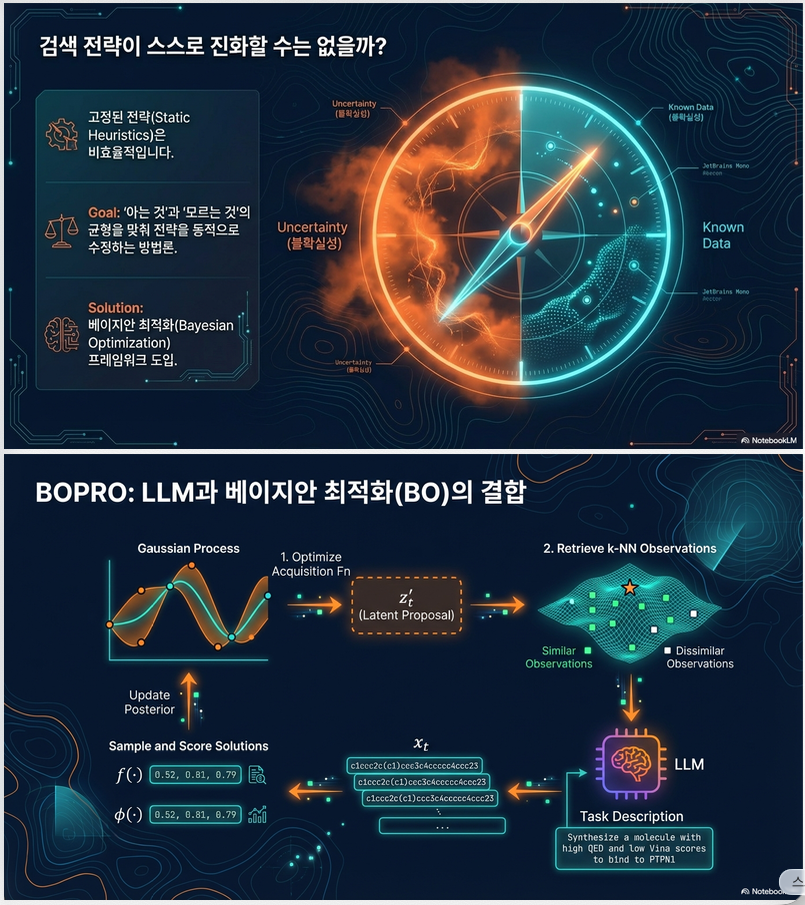
LLM 기반 탐색에서 exploration–exploitation trade-off를 자동으로 조절할 수 있는가?
이 논문은 여기에 대해 **Bayesian Optimization(BO)**을 활용한 해법을 제안합니다.
2. 제안 방법: Bayesian-OPRO (BOPRO)
핵심 아이디어
LLM을 단순히 반복 샘플링하지 않고,
- 잠재 공간(latent embedding space)에서 BO 수행
- BO가 제안한 latent vector 주변을 LLM이 생성하도록 프롬프트 구성
즉,
전체 구조 (Figure 1, p.2)
반복 루프 (iteration t)
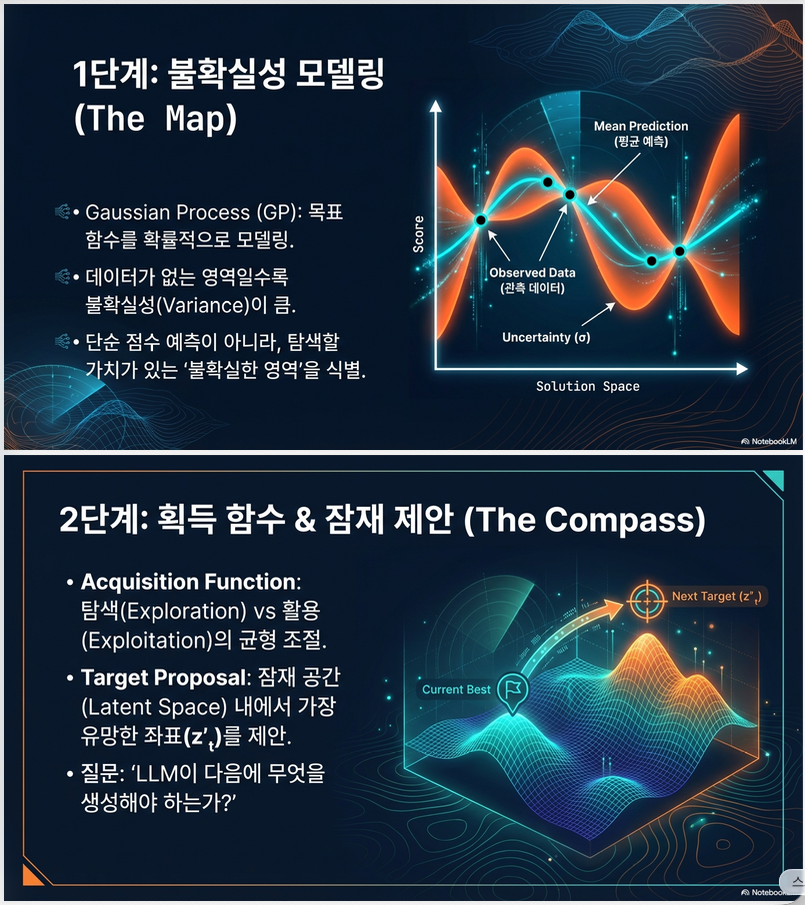
① Surrogate 모델 (GP)
이전 해들 로부터
를 추정
② Acquisition 최적화
- LogEI
- UCB
- Thompson Sampling
→ 다음에 탐색할 “유망한 잠재 위치” 결정
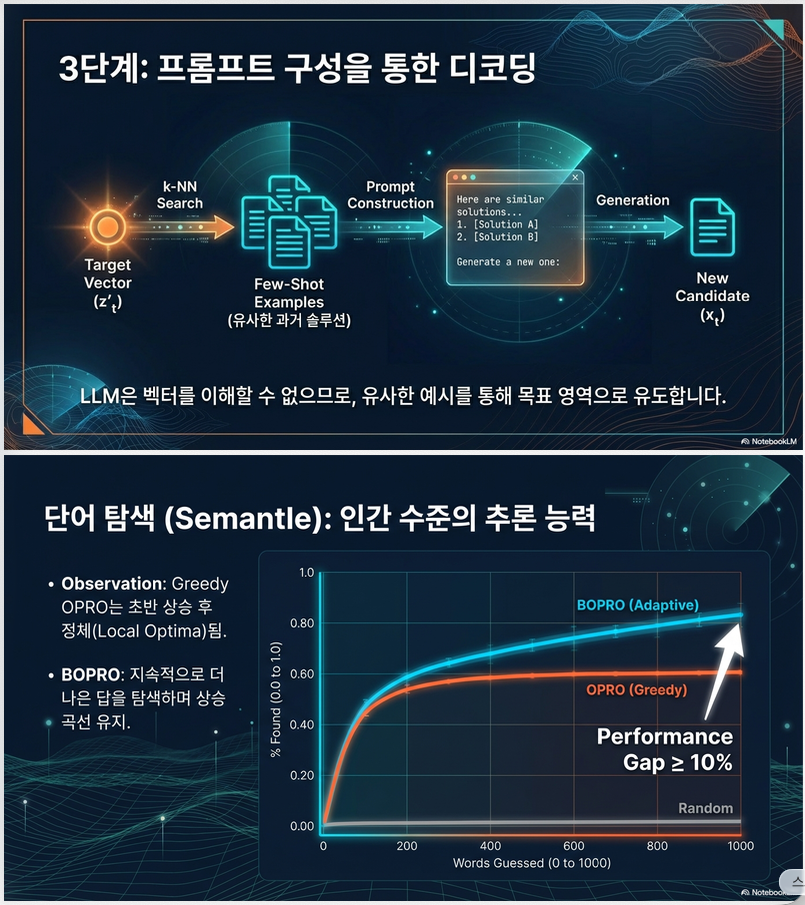
③ Latent → Text 디코딩
BO가 제안한 와 cosine similarity가 높은 이전 해 k개를 골라
→ 이를 in-context example로 사용
→ LLM이 새로운 해 생성
④ 평가 및 업데이트
black-box score 계산 → GP posterior 업데이트
이 과정을 반복
3. OPRO와의 차이
기존 OPRO:
- top-k (score 기준) 해를 prompt에 넣음
- 완전 greedy
- exploitation 중심
BOPRO:
- latent similarity 기준 선택
- GP uncertainty 활용
- exploration/exploitation 자동 균형
예시 (Semantle):
| 기존 단어 | score |
|---|---|
| word | 0.7 |
| sentence | 0.65 |
| lock | 0.5 |
| metal | 0.49 |
OPRO → word, sentence
BOPRO → lock, metal 선택 가능 → locksmith → wordsmith
4. 실험 설정
3개 탐색 문제에 적용:
(1) Semantle (단어 찾기)
- hidden word 찾기
- similarity 점수만 피드백
- 최대 1000 guess
(2) Dockstring (분자 최적화)
목표:
- QED (drug-likeness)
- Vina (binding affinity)
scalarized objective:
결과는 Figure 2(b), p.7
(3) 1D-ARC (가설 + 프로그램 탐색)
- 자연어 알고리즘 + Python 코드 생성
- train grid 모두 맞추는 프로그램 탐색
5. 주요 결과
Semantle (Figure 2a)
- BOPRO가 OPRO보다 ≥10%p 높음
- OPRO는 초반 급상승 후 plateau
- BOPRO는 steady improvement
→ local optimum 탈출 가능
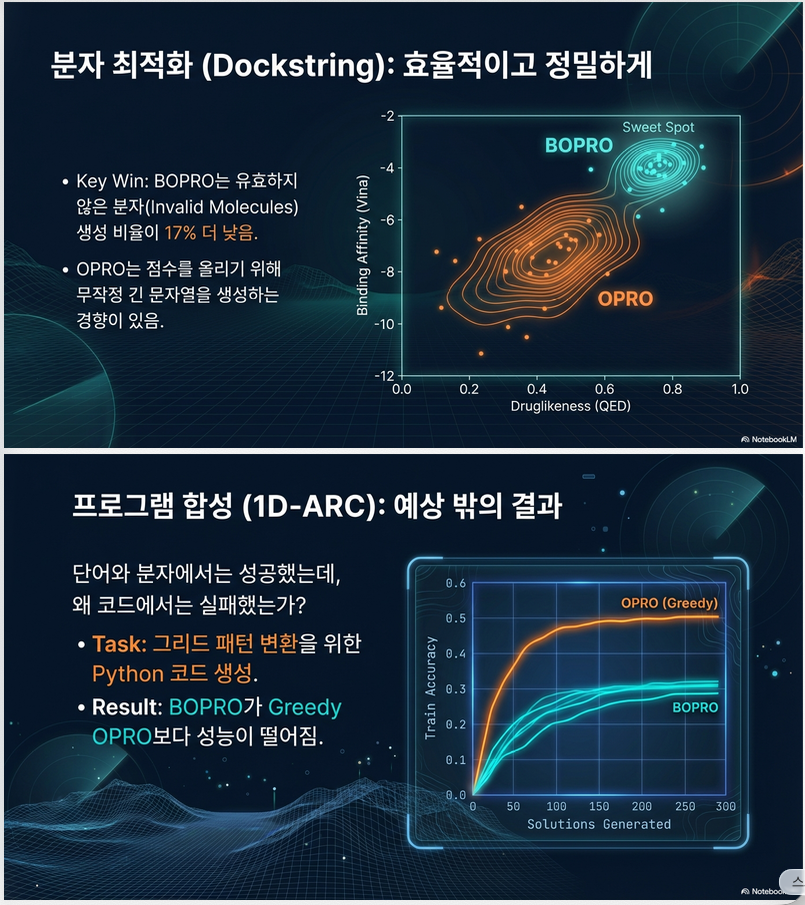
Dockstring (Figure 2b)
- BOPRO가 약간 더 높은 최적값
- OPRO는 17% 더 많은 invalid molecule 생성
- OPRO는 58개 중 12개 target만 완료
→ greedy는 분자 길이 과도 증가
1D-ARC (Figure 2c)
- BOPRO가 OPRO보다 낮음
- 심지어 RS보다도 낮음
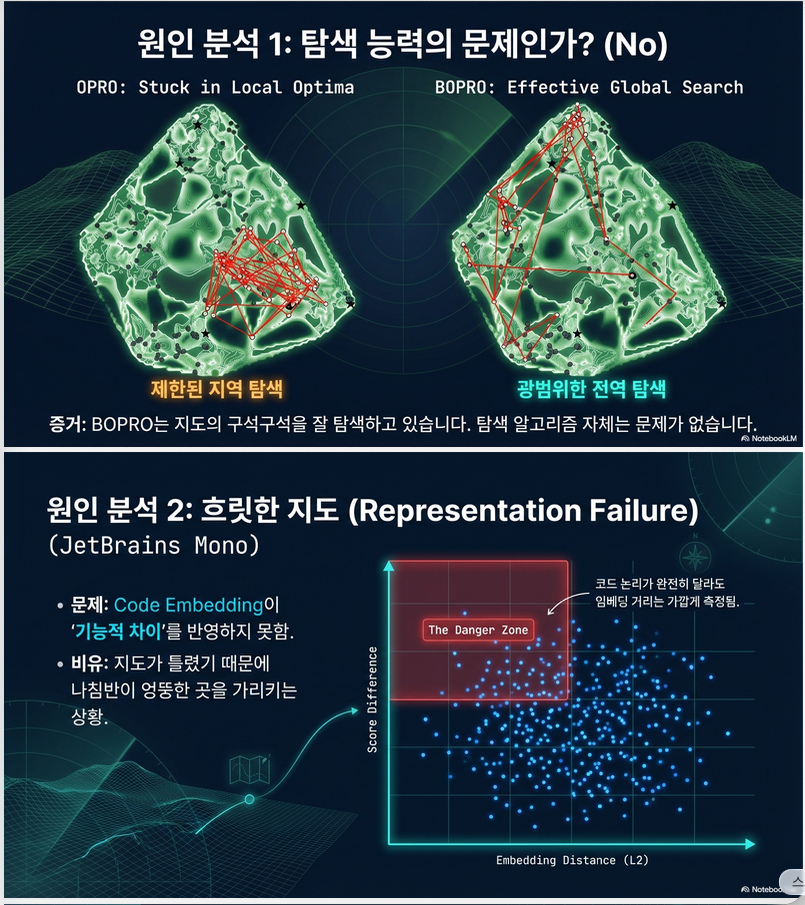
6. 실패 원인 분석 (Section 8)
질문 1: BOPRO가 exploration 못했나?
아님.
Figure 5 (p.9):
- low warm-start 문제에서 BOPRO는 잘 탐색함
- bimodal distribution → exploration/exploitation 균형
질문 2: Representation 문제?
Figure 6 (p.10)
scatter plot:
- x축: embedding distance
- y축: score difference
문제:
- L2 distance 작아도 score 차이 큼
즉,
코드 embedding이 fine-grained semantic 차이를 못 잡음
예:
if x > 3:vs
if x >= 3:embedding은 거의 동일
하지만 결과는 완전히 다름
→ GP surrogate가 의미 있는 smooth function을 학습 불가
7. 결론
| Task | 결과 |
|---|---|
| Word search | BOPRO 우수 |
| Molecule opt | BOPRO 우수 |
| Program search | representation 한계로 실패 |
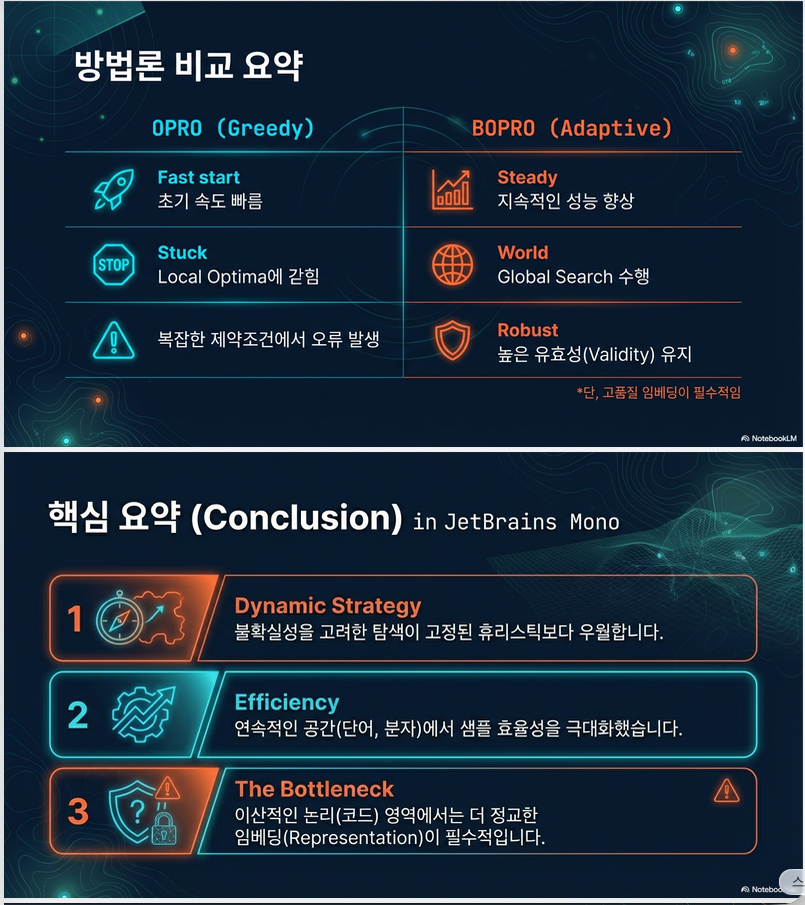
8. 이 논문의 이론적 의미
(1) LLM search = BO 문제로 재해석
LLM generation을 black-box optimization으로 공식화
(2) In-context optimization의 Bayesian generalization
OPRO → greedy heuristic
BOPRO → uncertainty-aware search
(3) Representation quality가 BO 성능의 병목
이 논문이 암묵적으로 말하는 것:
“LLM + BO”의 성패는 embedding geometry에 달려있다
다음은 논문의 **방법론(Methodology)**을 수식과 알고리즘 관점에서 정리한 것입니다
1. 문제 정식화
우리는 다음 black-box 최적화 문제를 푼다:
- x: LLM이 생성하는 텍스트 해 (단어, SMILES, 코드 등)
- f(x): 외부 검증기(black-box score)
- : 가능한 해 공간
- 예산 T: 평가 가능 횟수 제한
문제점:
텍스트 공간은 이산 + 고차원 → 직접 BO 불가능
2. 핵심 아이디어
Latent-space Bayesian Optimization
- 텍스트 해를 embedding으로 매핑
- latent 공간에서 BO 수행
- BO가 제안한 latent 위치 주변을 LLM이 생성하도록 프롬프트 구성
즉,
3. 전체 알고리즘 구조 (BOPRO)
반복 루프 (iteration t)
3.1 Warm Start
LLM으로 W개의 초기 해 생성
embedding 계산:
- : embedding model
- : optional dimensionality reduction (보통 identity)
3.2 Surrogate 모델 (Gaussian Process)
Latent space에서 GP 구성:
- kernel: Matern 5/2
- posterior:
3.3 Acquisition Function 최적화
다음 탐색 지점:
사용한 acquisition:
(1) Log Expected Improvement
(2) Upper Confidence Bound
(3) Thompson Sampling
4. Latent → Text 디코딩 (핵심 부분)
BO는 continuous latent vector 를 제안
하지만 우리는 텍스트를 생성해야 함
4.1 Similarity 기반 In-context Prompt 구성
이전 해들:
각 해와 cosine similarity 계산:
상위 k개 선택 → prompt 구성
4.2 LLM Generation
프롬프트에 k개 해 포함 후
batch decoding 사용
4.3 평가 및 업데이트
데이터셋 업데이트:
GP posterior 업데이트
5. OPRO와의 차이
| OPRO | BOPRO |
|---|---|
| score 기반 top-k | latent similarity 기반 |
| greedy exploitation | uncertainty-aware |
| local optima 위험 | exploration 가능 |
BOPRO는 OPRO의 Bayesian generalization
6. Error Handling
중복 생성
- 재샘플링
- 실패 시 BO proposal을 surrogate 업데이트에 사용
Invalid output
- self-refine loop
- 실패 시 score = -1
7. 알고리즘 요약 (Pseudo-code)
Initialize warm-start set
Compute embeddings

for t = 1 to T:
    Fit GP on (z_i, f_i)

    z_t' = argmax acquisition(z)

    Select k past solutions most similar to z_t'
    Construct prompt

    x_t = LLM(prompt)
    score = f(x_t)

    z_t = embedding(x_t)
    Add (z_t, score) to dataset

Return best x
8. 방법론의 핵심 기여
(1) LLM 탐색을 BO 문제로 정식화
(2) Latent-space surrogate 구축
(3) In-context prompting을 acquisition-driven sampling으로 재해석
9. 방법론의 이론적 장점
- Adaptive exploration
- Task difficulty에 자동 적응
- 정적 heuristic 불필요
- Greedy 대비 global optimum 탐색 가능성 증가
10. 병목 지점
핵심 가정:
1D-ARC에서 실패 원인:
- 코드 embedding이 fine-grained semantic 차이 반영 못함
- GP가 smooth function 학습 불가
즉,
Representation quality가 BO 성능을 결정
embedding model, dimensionality reduction 모델 구성(학습을 따로 하는가?), kernel: Matern 5/2 설명, Latent → Text 디코딩 예를 들어 설명
1. Embedding Model 구성
어떤 모델을 사용했는가?
Task별로 off-the-shelf embedding 모델을 사용합니다.
| Task | Embedding 모델 |
|---|---|
| Semantle | GTE-Qwen-2-1.5B-Instruct |
| 1D-ARC | GTE-Qwen-2-1.5B-Instruct (code + text 학습됨) |
| Dockstring | Molformer (SMILES 특화) |
학습을 따로 하는가?
아니오.
- embedding model은 사전학습(pretrained) 모델을 그대로 사용
- BO 과정 중 embedding을 업데이트하지 않음
- representation learning은 수행하지 않음
즉,
는 고정 함수입니다.
왜 fine-tuning을 하지 않았는가?
논문 목표는:
“LLM search 전략을 개선하는 것”
representation learning은 범위 밖으로 둠.
그러나 1D-ARC 실패 분석에서:
코드 embedding 품질이 문제
라고 명확히 지적합니다 (Section 8.2).
2. Dimensionality Reduction 모델 구성
논문에서 언급된 ψ(·):
가능한 옵션:
- PCA
- Random Projection
- Low-rank projection
학습 여부?
PCA:
- warm-start 또는 unlabeled set 기반으로 fitting 가능
- 그러나 논문 기본 설정은:
dimensionality reduction을 사용하지 않는 것이 가장 성능이 좋음
즉,
(Identity)
왜 reduction이 필요할 수 있는가?
GP는 high-dim에서 어려움:
- kernel lengthscale 학습 불안정
- curse of dimensionality
하지만 실험에서는:
- embedding 차원이 그렇게 크지 않음
- reduction이 오히려 정보 손실 유발
3. Matern 5/2 Kernel 설명
GP에서 kernel은:
k(z, z’)
를 정의.
논문에서 사용:
Matern 5/2 kernel
수식
Matern ν=5/2:
여기서:
왜 Matern 5/2인가?
RBF와 비교
| Kernel | Smoothness |
|---|---|
| RBF | infinitely smooth |
| Matern 5/2 | twice differentiable |
| Matern 3/2 | once differentiable |
BO에서 중요한 점:
- RBF는 너무 smooth 가정
- 실제 black-box function은 rough함
특히 텍스트 생성 문제에서는:
local ruggedness 존재
Matern 5/2는 적절한 trade-off.
직관
- 가까우면 유사한 점수
- 너무 멀면 독립
그러나 1D-ARC에서 이 가정이 깨짐:
가까워도 점수 크게 다름
→ GP surrogate 실패
4. Latent → Text 디코딩 예시
이 부분이 BOPRO의 가장 중요한 설계입니다.
상황 예시: Semantle
Hidden word: “wordsmith”
현재 관측:
| Word | Score |
|---|---|
| word | 0.7 |
| sentence | 0.65 |
| lock | 0.5 |
| metal | 0.49 |
embedding 계산 후 BO가 제안:
Step 1: Similarity 계산
각 이전 와 cosine similarity:
가장 가까운 k개 선택.
예를 들어:
- lock
- metal
선택됨.
Step 2: Prompt 구성
Here are some candidate words:
1. lock
2. metal

Generate a new word similar to the above.
(점수는 포함하지 않음 — 실험적으로 성능 개선)
Step 3: LLM 생성
LLM:
locksmith다음 iteration:
wordsmith발견.
5. Program Search 예시 (1D-ARC)
BO proposal vector → cosine 유사한 코드 3개 선택
예:
Algorithm:
If a block of color X appears, duplicate it to the right.

Code:
def solve(grid):
    ...
Prompt:
Here are previous candidate solutions:

[Sol 1]
Algorithm: ...
Code: ...

[Sol 2]
Algorithm: ...
Code: ...

Generate a new solution combining ideas.
왜 실패했는가?
두 코드가 embedding상 매우 가깝지만:
if x > 3:vs
if x >= 3:output은 완전히 달라짐.
즉:
→ GP smoothness 가정 붕괴
6. Latent→Text의 근본적 한계
BO는 continuous vector 제안
LLM은 discrete text 생성
문제:
mapping이 정확하지 않음.
논문에서도:
latent proposal을 정확히 text로 변환하는 방법은 future work
라고 명시.
7. 전체 구조 요약
Text x
  ↓ φ
Embedding z
  ↓ GP + Matern 5/2
Posterior
  ↓ acquisition
z'
  ↓ cosine similarity selection
Prompt
  ↓ LLM
x'
  ↓ evaluate
score
  ↓ update GP
8. 핵심 통찰
성능을 결정하는 요소는 3가지:
- Embedding geometry
- Kernel smoothness assumption
- Latent→text decoding fidelity
논문에서의 BO hyperparameter 학습 방식을 구현 레벨 + 수학적 관점에서 정리하겠습니다.
1. 사용한 Surrogate 구조
- Surrogate: Gaussian Process
- Kernel: Matern 5/2
- 구현: BoTorch + GPyTorch
- Output standardization 사용
- Input normalization은 사용하지 않음 (embedding이 이미 normalized)
2. Hyperparameter 구성
GP에서 학습/설정되는 주요 하이퍼파라미터:
| 기호 | 의미 |
|---|---|
| lengthscale | |
| output scale (signal variance) | |
| observation noise | |
| m | mean function |
3. Lengthscale Prior
논문에서 사용:
Gamma prior
- concentration = 4
- rate = 2
왜 Gamma인가?
- 양수 제약 필요
- skewed distribution 가능
- BO에서 표준적 선택
4. Outputscale Prior
signal variance 제어
5. Mean Function Prior
이 값은:
- score 범위가 [0,1]일 때
- 평균 근처에서 시작하도록 설정
6. Noise Variance
고정 small noise
이유:
- black-box score는 deterministic
- 하지만 numerical 안정성 위해 작은 noise 추가
7. Hyperparameter 학습 방식
중요:
논문에서는 fully automatic marginal likelihood optimization을 강조하지 않음.
대신:
“Manual prior tuning”
절차:
- known solution-score pairs 샘플링
- BO를 몇 step 돌려 posterior mean/variance 시각화
- posterior가 ground-truth를 잘 따라가는지 확인
- prior 조정
즉,
heuristic + visual inspection 기반 tuning
8. Marginal Likelihood 관점
일반적인 GP hyperparameter 학습은:
여기서
BoTorch 기본 동작은:
- prior 설정
- MLL (marginal log likelihood) gradient ascent
하지만 이 논문은:
prior를 먼저 잘 설정하는 것에 초점
9. ARD 설정
논문 설정:
ard_num_dims = 1즉,
모든 차원 동일 lengthscale.
이유:
- 데이터 적음
- ARD는 과적합 위험
- embedding dimension 크면 불안정
10. 왜 hyperparameter 학습이 중요한가?
BO의 성능은 사실상:
에 달려있음.
특히 exploration은:
에 의존.
lengthscale이 너무 작으면:
- overfitting
- local exploration
너무 크면:
- underfitting
- global smooth 가정
11. 1D-ARC 실패와의 연결
Embedding 문제로 인해:
→ kernel smoothness 가정 붕괴
이 경우:
- lengthscale 조정해도 해결 불가
- representation 자체 문제
12. 요약
| 요소 | 설정 |
|---|---|
| Surrogate | GP |
| Kernel | Matern 5/2 |
| Lengthscale prior | Gamma(4,2) |
| Outputscale prior | Gamma(4,2) |
| Mean prior | Normal(0.4,0.01) |
| Noise | 0.001 |
| ARD | 비활성 |
| 학습 방식 | prior tuning + MLL |
답글 남기기