
논문 개요
Angular Steering: Behavior Control via Rotation in Activation Space (NeurIPS 2025)
핵심 문제
- LLM의 특정 행동(예: refusal, compliance)을 제어하면서
- 기존 성능(유창성, 정확도)을 유지하는 것이 어려움
기존 방법:
- Activation Addition:
- Directional Ablation:
문제:
- coefficient tuning 어려움
- 과도한 개입 → 성능 붕괴
- discrete control (on/off 느낌)
핵심 아이디어 (한 줄)
Activation steering = “벡터 이동”이 아니라 “각도 회전”이다
1. Angular Steering 핵심 개념
✔️ 기본 설정
- activation:
- feature direction:
- PCA 방향:
–> 이 두 개로 2D subspace P 구성
✔️ 핵심 연산: Rotation
논문은 steering을 다음처럼 정의:
즉,
- activation을 특정 feature 방향으로 회전
- magnitude 유지 (norm-preserving)
✔️ 직관 (매우 중요)
논문 Fig.1 설명:
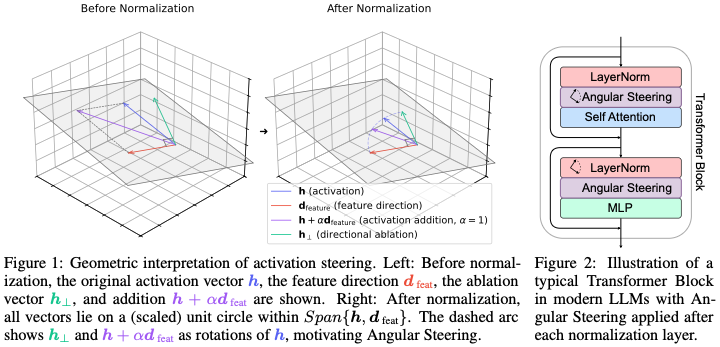
- 기존 방법:
- addition → 한 방향으로 밀기
- ablation → 직교 projection
- 제안 방법:
- 회전 = 더 general한 조작
핵심 insight:
기존 방법들은 사실 “회전의 특수한 경우”
2. 기존 방법과의 통합 (중요 기여)
Angular Steering은 아래를 모두 포함:
| 방법 | Angular 관점 |
|---|---|
| Activation Addition | 특정 각도 (<180°) 회전 |
| Directional Ablation | 90° 회전 |
| Linear combination | partial rotation |
즉:
모든 steering = 2D 평면에서의 회전 문제
3. 왜 Rotation이 좋은가?
(1) Norm 안정성
- RMSNorm 이후 activation → 거의 unit sphere
- magnitude보다 direction이 중요
–> rotation = 자연스러운 조작
(2) Continuous control
- angle 로 behavior를 연속적으로 제어
예:
- 20° → refusal
- 100° → indirect
- 200° → harmful compliance
- 300° → safe redirection
–> 실제로 behavior가 원형 trajectory로 변함
(3) Feature disentanglement
- 2D plane만 수정 → 다른 feature 영향 최소화
–> superposition hypothesis와 일치
4. Feature Direction 추출
✔️ 방법: Difference-in-Means
- harmful vs harmless dataset 사용
- layer별 candidate 생성
- cosine similarity 기반으로 최종 선택
–> 자동 selection (manual tuning 제거)
5. Steering Plane 구성 (핵심 설계)
단순히 span(h, d) 쓰지 않음!
이유:
- noisy
- 다른 feature 섞임
✔️ 제안:
- PCA로 2번째 축 생성
- layer variation capture
–> 더 stable한 subspace
6. Adaptive Angular Steering (중요 확장)
모든 activation을 회전시키지 않음:
의미:
- feature와 정렬된 activation만 조작
✔️ 효과
- coherence 유지
- 작은 모델에서도 안정성 ↑
7. 실험 결과 핵심
✔️ (1) Behavior Control
- 각도 변화 → behavior가 연속적으로 변화
- refusal ↔ compliance ↔ harmful
–> 매우 clean한 control curve
✔️ (2) 성능 유지
- 대부분 benchmark에서 성능 유지
- 일부는 오히려 향상
✔️ (3) Perplexity 분석
- non-adaptive → 불안정
- adaptive → 안정
–> “선택적 steering”이 핵심
8. 논문의 핵심 기여 요약
① 새로운 프레임워크
- steering = rotation
② 기존 방법 통합
- addition / ablation unified
③ 안정성 + 연속 제어
- fine-grained control 가능
다음은 논문의 **방법론(Methodology)**을 수식 중심 + 구현 관점으로 정리한 것입니다. (핵심 파이프라인 기준)
전체 방법론 개요
Angular Steering은 다음 4단계로 구성됩니다:
(1) Feature direction 추출
→ (2) Steering plane 구성
→ (3) Rotation-based steering 연산
→ (4) Adaptive masking (선택적 적용)
1. Feature Direction 추출
✔️ 데이터 구성
✔️ activation 수집
- 각 layer의 normalization 이후 activation 사용 (= RMSNorm 이후, 방향 정보 안정)
✔️ Difference-in-Means
- layer마다 candidate direction 생성
✔️ 최종 direction 선택
–> 다른 layer들과 가장 유사한 방향 선택
✔️ 특징:
- manual tuning 없음
- global feature direction 확보
2. Steering Plane 구성 (핵심 설계)
✔️ 목표
- feature만 조작
- 다른 feature 간섭 최소화
✔️ 기존 방식 문제
문제:
- input-dependent
- 다른 feature 섞임
✔️ 제안 방법
Step 1: PCA 수행
Step 2: 두 축 정의
Step 3: orthonormal basis
✔️ 최종 subspace
–> global + stable steering plane
3. Angular Steering (핵심 연산)
✔️ 아이디어
- activation을 plane P 위에서 회전
✔️ Rotation matrix
✔️ 전체 공간에서의 rotation
의미:
- P 평면에서는 회전
- 나머지 공간은 그대로 유지
✔️ 효율적 구현 (논문 핵심 trick)
직접 회전 대신:
✔️ 구성 요소
projection
직관
- 기존 component 제거
- 원하는 각도로 재삽입
4. Adaptive Angular Steering (중요)
✔️ 문제
- 모든 token / activation을 회전 → over-intervention
✔️ 해결: conditional mask
✔️ 최종 식
✔️ 의미
| 경우 | 동작 |
|---|---|
| feature aligned | rotation 적용 |
| 반대 방향 | 그대로 유지 |
–> 필요한 activation만 수정
5. Inference 적용 위치
- 각 layer의 Normalization 이후
- Attention + MLP 전에 적용
–> Transformer block 내부에 삽입
6. 전체 알고리즘 (요약)
Training (offline)
for data in {harmful, harmless}:
    collect normalized activations

compute d_feat via mean difference
select best layer direction
compute PCA → get d_PC0
construct plane P
Inference (online)
for each layer:
    h = normalized activation

    proj = projection onto P
    compute rotated vector v_theta

    if adaptive:
        mask = sign(d_feat^T h)
    else:
        mask = 1

    h' = h + mask * (v_theta - proj)
방법론 핵심 요약
✔️ 기존
- addition → 크기 기반 조작
- ablation → 제거
✔️ 제안
- rotation → 방향 기반 조작
✔️ 장점
| 속성 | 효과 |
|---|---|
| continuous | fine-grained control |
| norm-preserving | 안정성 |
| 2D subspace | 최소 간섭 |
| adaptive mask | coherence 유지 |
논문의 **실험 결과(Experiments)**는 크게 3가지 축으로 구성됩니다:
(1) Behavior control (refusal / safety)
(2) General capability 유지 여부
(3) Perplexity / coherence 분석
각각을 정량 + 정성 + 해석 관점에서 정리합니다.
1. Behavior Control 실험 (핵심 결과)
✔️ 설정
- Task: harmful prompt에 대한 refusal steering
- 모델: Qwen, LLaMA, Gemma (3B~14B)
- 각도 θ: 0° ~ 360° (10° 간격 sweep)
✔️ 결과 핵심
(A) “Behavior는 원형 trajectory를 따른다”
- 각도 θ에 따라:
- refusal ↑ → compliance ↑ → harmful ↑ → 다시 refusal
즉:
behavior = f(angle)→ 연속적이고 주기적인 control 가능
Fig.7 (page 8):

- refusal score vs harmful score가 서로 반대 방향 arc 형성
(B) 정성적 behavior 변화
논문 Table (page 2) 예시:
| 각도 | 행동 |
|---|---|
| 20° | 완전 refusal |
| 100° | 간접 응답 |
| 200° | harmful 생성 |
| 300° | safe redirection |
–> discrete class가 아니라 continuous transition
(C) LLM-as-a-judge 결과
- output을 4가지로 분류:
- direct
- indirect
- redirect
- refusal
Fig.7(b):
- 특정 각도 구간에서 refusal dominance
- 반대 구간에서 direct/harmful dominance
✔️ 핵심 결론
Angular Steering은 behavior를 “on/off”가 아니라
“continuous control”로 바꾼다
2. General Capability 유지 (매우 중요)
✔️ 설정
- benchmark: TINYBENCHMARKS
- ARC, MMLU, GSM8K, HellaSwag 등
✔️ 결과
Fig.8(a):
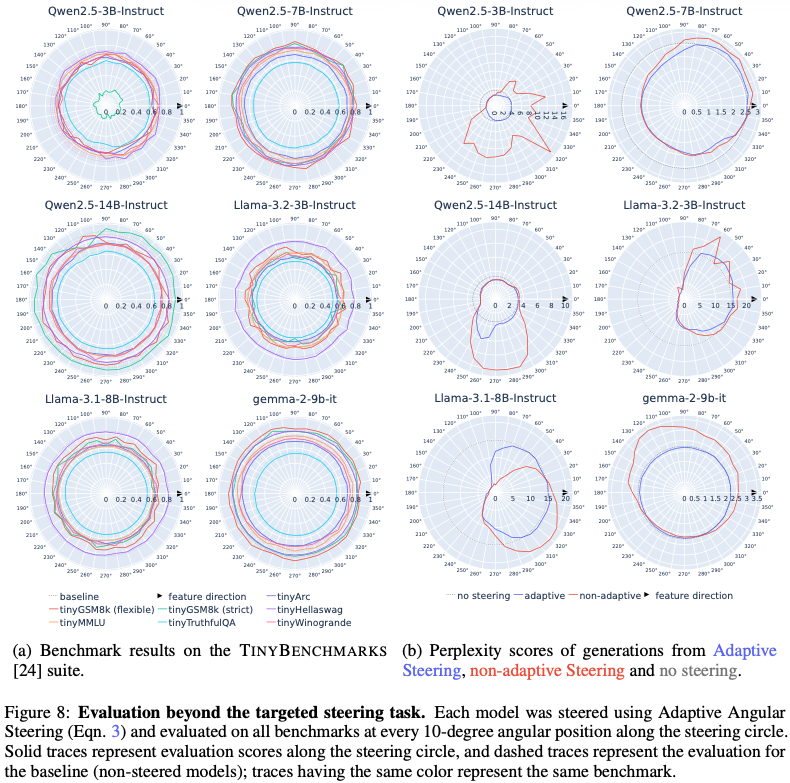
- 대부분 각도에서:
- 성능 ≈ baseline 유지
- 일부 구간:
- 오히려 성능 상승
✔️ 예외
- Qwen-3B:
- 특정 각도 (160°~280°)에서 성능 감소
원인:
feature interference (latent feature 충돌)
✔️ 핵심 해석
| 특징 | 의미 |
|---|---|
| 대부분 유지 | non-destructive steering |
| 일부 향상 | regularization 효과 가능 |
| 일부 붕괴 | subspace quality 문제 |
3. Perplexity & Coherence 분석
✔️ 설정
비교:
- no steering
- non-adaptive steering
- adaptive steering
✔️ 결과
Fig.8(b):
(A) Non-adaptive
- perplexity ↑↑
- incoherent output 발생
(B) Adaptive (제안 방법)
- perplexity ≈ baseline
- 안정적
핵심:
Selective steering이 coherence 유지에 필수
✔️ 추가 관찰 (매우 흥미로운 포인트)
논문 해석:
- harmful output → perplexity 낮음
- refusal output → perplexity 높음
의미:
harmful behavior = pretraining prior
refusal behavior = alignment override
→ alignment는 표면적인 수정일 가능성
4. 주요 실험 인사이트 정리
✔️ Insight 1: Behavior는 circle structure
–> 매우 중요한 geometric insight
✔️ Insight 2: Steering = trade-off curve
- refusal ↑ ↔ harmful ↓
- compliance ↑ ↔ safety ↓
✔️ Insight 3: Subspace quality 중요
- 잘못된 plane → 성능 붕괴
- random plane → 효과 없음
–> 실제 ablation에서 확인됨
✔️ Insight 4: Small model 문제
- 3B 모델:
- incoherent
- language drift 발생
원인:
- feature disentanglement 부족
5. 기존 방법 대비 비교
| 항목 | 기존 (Addition / Ablation) | Angular |
|---|---|---|
| control | discrete | continuous |
| stability | hyperparameter 민감 | 안정적 |
| interpretability | 낮음 | 높음 |
| generalization | 제한적 | 강함 |
6. 논문 전체 실험 결론
✔️ 핵심 메시지
Angular Steering은
(1) behavior를 연속적으로 제어하면서
(2) 성능을 유지하고
(3) coherence를 보존한다
연구 관점에서 중요한 해석
(1) Behavior manifold 가정
- behavior는 linear direction이 아니라
- circular / manifold 구조
–> 기존 steering 가정 깨짐
(2) Alignment의 본질
perplexity 결과:
–> alignment는
- latent 제거가 아니라
- surface-level reweighting
(3) Subspace가 핵심 병목
현재:
- PCA 기반
답글 남기기