1. 연구 배경: Latent Space Bayesian Optimization (LSBO)
1.1 문제: 고차원/구조 데이터 최적화
많은 과학 문제는 다음 형태의 Black-box optimization이다.
예:
- 화학 분자 → docking score
- 이미지 → classifier score
- 단백질 → binding affinity
문제는:
- x 가 고차원 구조 데이터
- 평가 비용이 매우 큼 (실험, 시뮬레이션)
그래서 사용하는 방법이 Bayesian Optimization (BO).
1.2 BO의 기본 아이디어
BO는 다음 과정을 반복한다.
(1) surrogate model (보통 Gaussian Process) 학습
(2) acquisition function 사용
예:
- UCB
- Expected Improvement
- Probability of Improvement
(3) 실제 함수 평가
(4) 데이터 업데이트
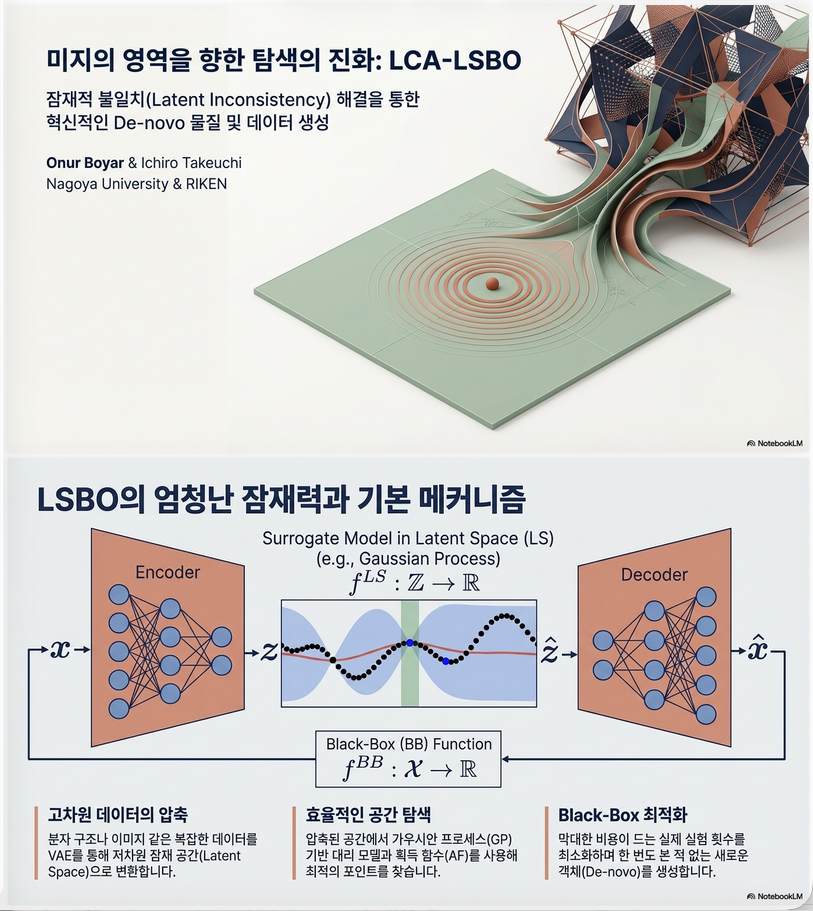
2. LSBO: Latent Space Bayesian Optimization
고차원 문제 해결을 위해 등장한 방법.
핵심 아이디어:
input space X (high dimension)
        ↓
      encoder
        ↓
latent space Z (low dimension)
        ↓
Bayesian Optimization
        ↓
      decoder
        ↓
candidate x
즉
(1) VAE로 latent space 생성
(2) BO는 latent space에서 수행
논문 그림 (p.2) 구조:
x → encoder → z
z → GP surrogate
z* ← acquisition function
z* → decoder → x*
fBB(x*)
3. 기존 LSBO의 핵심 문제
논문의 핵심 contribution은 LSBO의 두 가지 구조적 문제 발견이다.
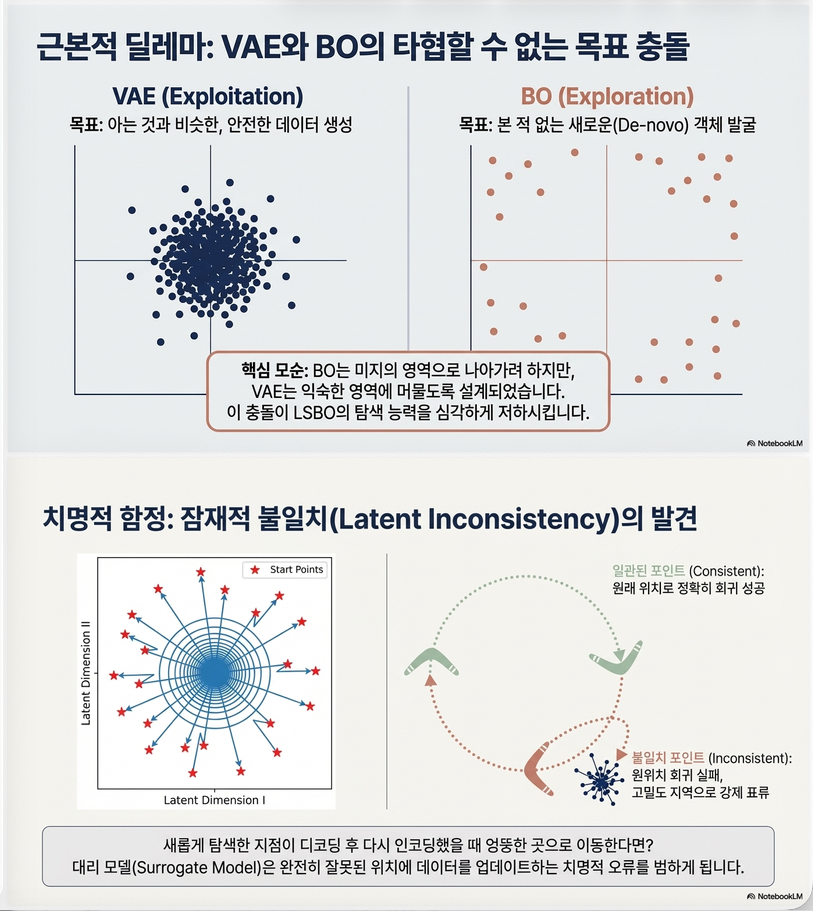
문제 1: VAE–BO objective mismatch
VAE 목적:
training data 근처 샘플 생성BO 목적:
새로운 영역 탐색즉
| 모델 | 목표 |
|---|---|
| VAE | dense region |
| BO | sparse region |
결과:
- latent space exploration 실패
- off-target generation
4. 핵심 개념: Latent Consistency
논문이 새로 정의한 개념.
latent point z 에 대해
decode → encode하면
latent consistent
latent inconsistent
논문 정의:
latent variable is consistent if repeated encode–decode cycles converge to the same point.
왜 문제가 되는가?
BO는
z → decode → x → fBB(x)하지만 실제 평가되는 latent point는
즉, BO surrogate는 z에서 학습. 실제 데이터는 z1에서 생성
→ surrogate update mismatch
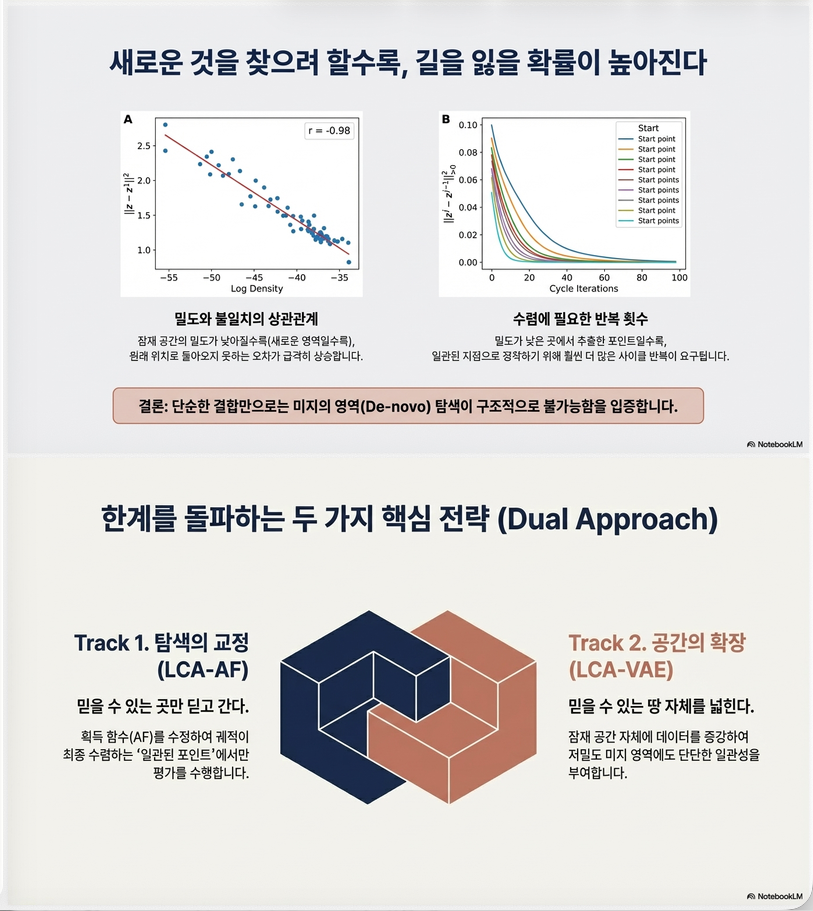
중요한 관찰
논문 실험 (p.8)
latent density ↓
→ inconsistency ↑
즉
sparse region = inconsistent하지만 BO는
exploration → sparse region결과:
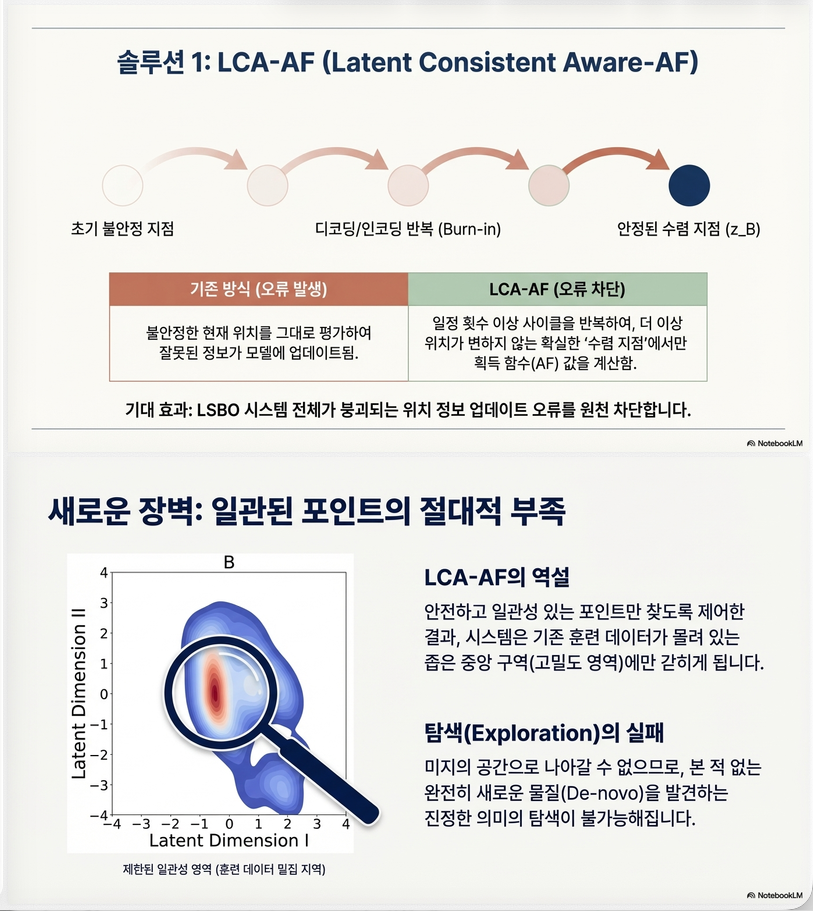
BO exploration이 망가짐5. 두 번째 문제: Limited Consistent Points
consistent point는 대부분
latent center근처에 존재.
즉, exploration 영역에는 consistent point가 거의 없음
결과: LSBO → exploitation only
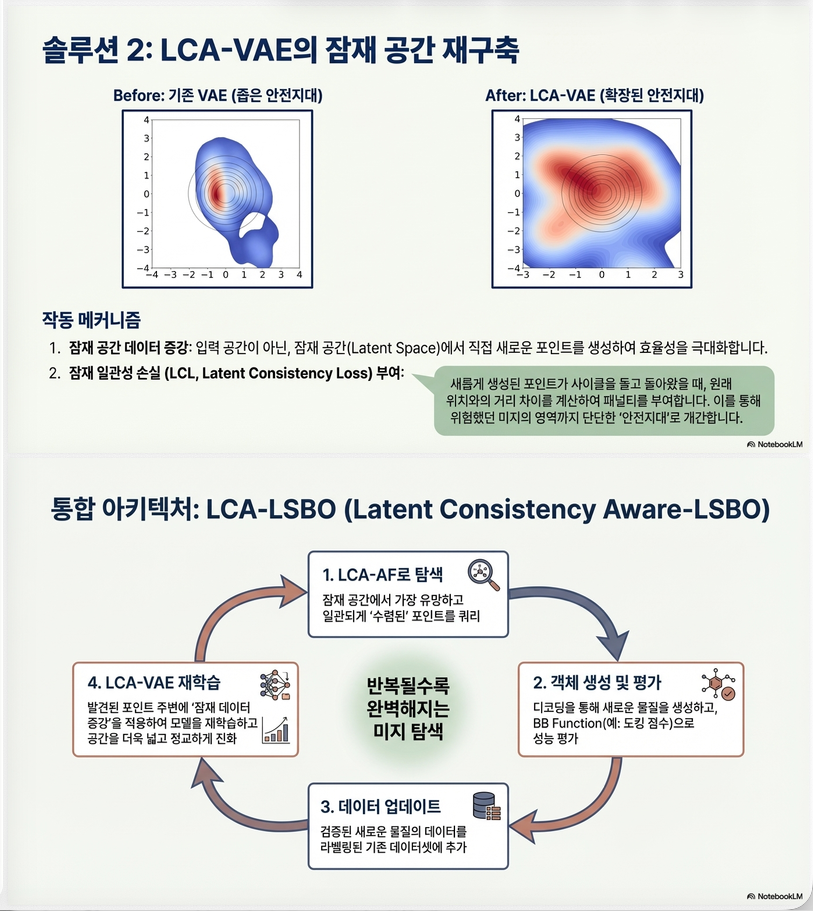
6. 해결 방법
논문은 두 가지 방법 제안.
1. LCA-AF
2. LCA-VAE
그리고 둘을 결합
LCA-LSBO7. Method 1: LCA-AF (Latent Consistency Aware Acquisition Function)
아이디어:
BO가 consistent point만 탐색하도록 한다방법
latent cycle 수행
z → decode → encode여러 번 반복
burn-in 이후
를 consistent point로 사용.
Acquisition function 계산:
실제로는 사용.
LCA-AF algorithm
for each BO iteration:

1. GP surrogate 학습
2. z* = argmax LCA-AF
3. x* = decoder(z*)
4. y* = fBB(x*)
5. dataset update
6. VAE retrain
8. Method 2: LCA-VAE
문제: consistent point 수가 너무 적다
해결: latent consistency loss
Latent Consistency Loss
여기서
새로운 VAE objective
기존:
새 objective:
즉, encode(decode(z)) ≈ z 되도록 latent space 학습.
9. Latent Data Augmentation
논문 핵심 아이디어.
기존: data augmentation → input space
논문: data augmentation → latent space
왜?
latent space 장점:
- low dimension
- Gaussian structure
- label-free augmentation
Pretraining 단계
reference distribution
여기서
→ sparse region augmentation
BO 단계
augmentation 중심
즉, promising region 주변 latent augmentation
10. 최종 알고리즘: LCA-LSBO
전체 흐름
1. LCA-VAE pretrain
2. BO iteration 반복
각 iteration
1 GP 학습
2 z* = argmax LCA-AF
3 x* = decoder(z*)
4 y* = fBB(x*)
5 dataset update
6 latent augmentation
7 LCA-VAE retrain
11. 실험
논문은 3개 task 수행.
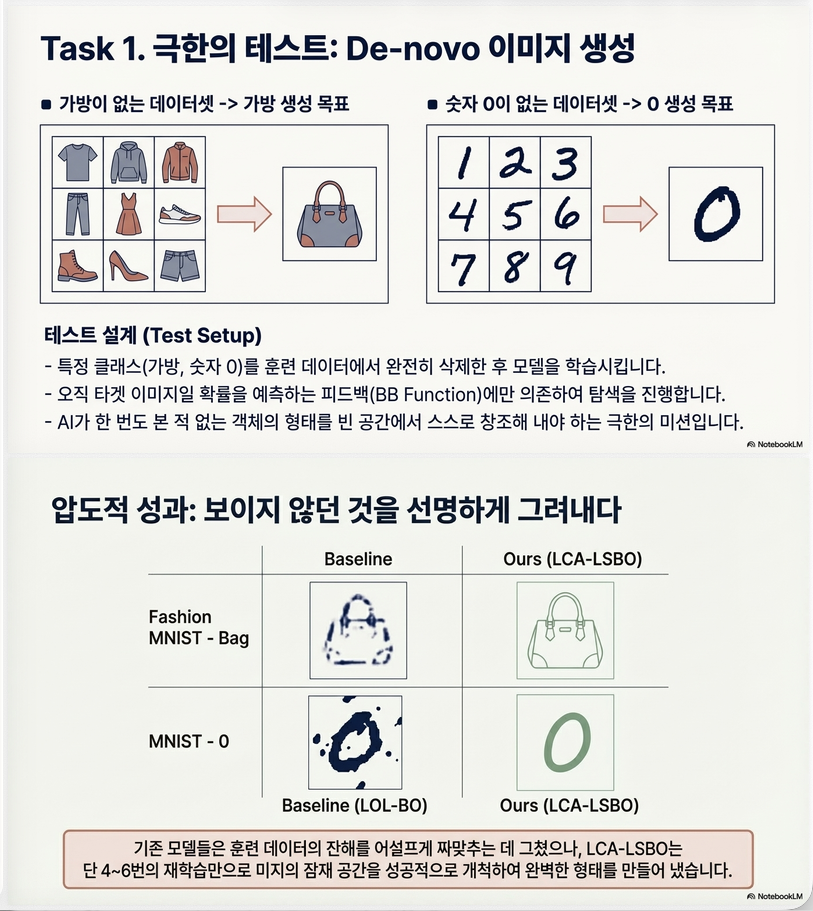
11.1 De-novo Image Generation
두 dataset 사용:
- Fashion-MNIST
- MNIST
실험 설정:
VAE training 시 특정 class 제거예:
bag 없이 학습
→ bag 생성
또는
digit 0 없이 학습
→ digit 0 생성
결과
기존 LSBO: target 생성 실패
LCA-LSBO: few iterations 후 성공
예:
bag generation
4 iteration → bag-like
6 iteration → near-perfect
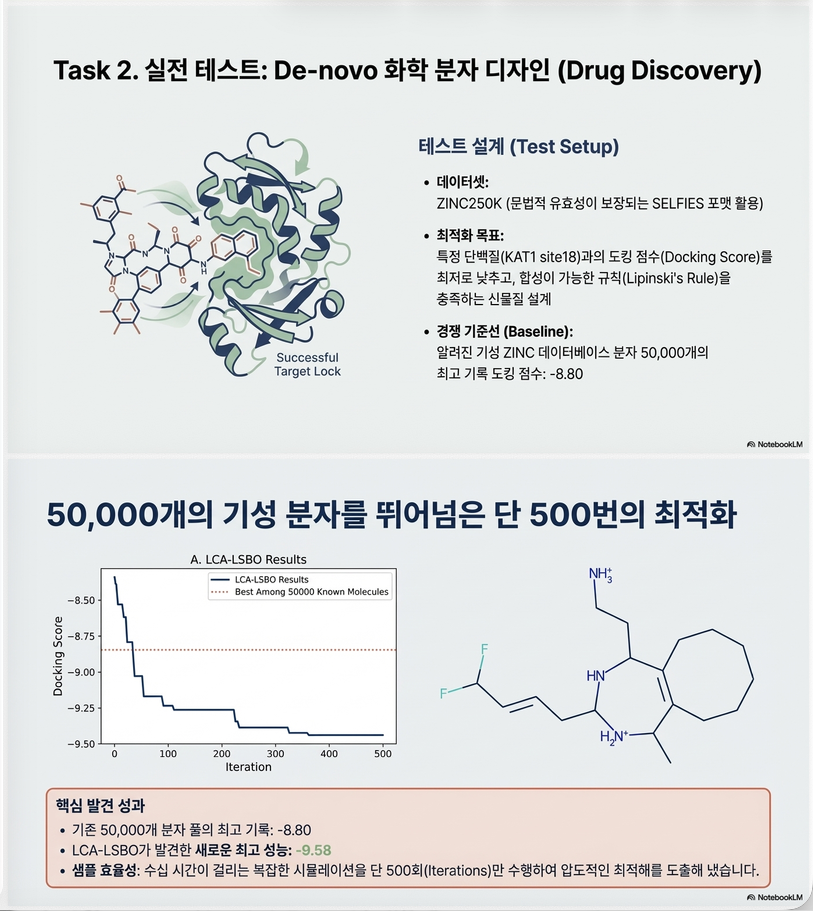
11.2 Chemical Design
dataset: ZINC250K
목표: docking score 최소화
baseline: random 50k molecules
결과
| method | best docking |
|---|---|
| ZINC | -8.80 |
| LCA-LSBO | -9.58 |
500 iterations 만에 발견.
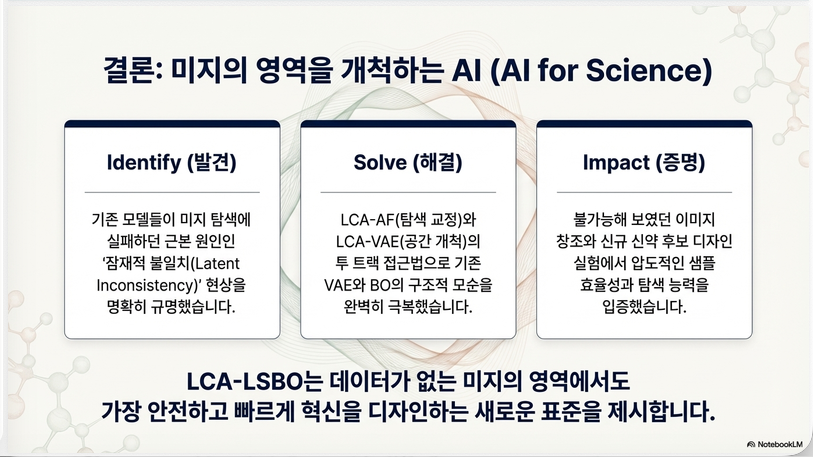
12. 핵심 기여 정리
논문 contribution
(1) Latent Consistency 개념 제안
latent optimization의 핵심 문제 분석.
(2) LCA-AF
consistent point 기반 BO.
(3) LCA-VAE
latent augmentation + consistency loss.
(4) LCA-LSBO
두 방법 결합 → sample-efficient BO.
13. 연구적으로 중요한 의미
이 논문은 LSBO 연구에서 중요한 insight 제공.
기존 접근
latent space + BO이 논문
latent geometry 문제 분석핵심 메시지
LSBO failure ≠ BO 문제
LSBO failure = latent inconsistency
14. LLM 연구와 연결 (중요)
이 논문 아이디어는 최근 LLM 연구와 매우 밀접합니다.
예:
LLM latent BO
- prompt optimization
- jailbreak suffix search
- latent instruction search
대표 논문
- GASP
- LOL-BO
- INSTRUCTZERO
- LBO prompt search
특히 중요한 연결
suffix optimization을
token → embedding → BO로 할 때
exactly 같은 문제 발생
embedding → text → embedding→ latent inconsistency
그래서 이 논문은
LLM latent BO research에서도 매우 중요한 reference입니다.
논문의 **방법론(Methodology)**는 크게 다음 세 가지 구성요소로 이루어집니다.
1. LCA-AF (Latent Consistency-Aware Acquisition Function)
2. LCA-VAE (Latent Consistency-Aware Variational Autoencoder)
3. LCA-LSBO (두 방법을 결합한 최종 LSBO 알고리즘)
각 구성 요소를 문제 정의 → 수식 → 알고리즘 구조 순서로 설명하겠습니다.
1. 기본 프레임워크: LSBO
문제 설정:
- : expensive black-box function
- 예: docking score, classifier score 등
하지만 x 가
- 분자
- 이미지
- 구조 데이터
처럼 고차원이기 때문에 BO를 직접 적용하기 어렵습니다.
그래서 사용하는 방법이 Latent Space Bayesian Optimization (LSBO) 입니다.
LSBO 구조
입력 공간:
latent 공간:
VAE 사용: ,
BO는 latent space에서 수행됩니다.
BO surrogate:
BO iteration:
(1) latent encoding
(2) GP surrogate 학습
(3) acquisition optimization
(4) decoding
(5) black-box evaluation
(6) dataset update
2. 문제 1: Latent Inconsistency
논문에서 정의한 핵심 개념입니다.
latent point z 에 대해 decode → encode를 수행하면
정의
Latent Consistent
또는
(encode-decode cycle 반복 후 동일 위치)
Latent Inconsistent
즉 latent point가 decode → encode 후 다른 위치로 이동.
논문 정의:
A latent point is consistent if repeated encoder-decoder cycles converge to the same point.
왜 문제가 되는가
BO는 z 선택
하지만 실제 평가되는 것은
x = decoder(z)그리고 다시 encoding하면 z1
즉, BO surrogate는 z 기준
실제 데이터는 z1 기준
→ surrogate 학습 오류 발생.
3. Method 1: LCA-AF
(Latent Consistency-Aware Acquisition Function)
아이디어: consistent point만 BO에 사용
3.1 Latent cycle 계산
latent point z 에 대해 반복:
논문에서 이를 cycle이라 부릅니다.
Algorithm: Latent cycle
Input: z

for j = 1..M
    z_j = enc(dec(z))
    z = z_j
burn-in 이후
를 사용.
3.2 Consistent point 판별
consistent point 조건:
즉 cycle이 수렴.
3.3 LCA-AF 계산
기존 acquisition:
LCA-AF:
즉, cycle 이후 AF 평균
하지만 실제 구현은 사용.
이렇게 하면 inconsistent point 영향 제거
4. Method 2: LCA-VAE
문제:
consistent point 수가 매우 적다특히, low density region에서 거의 없음.
하지만 BO는 low density region 탐색해야 합니다.
4.1 Latent Consistency Loss
latent variable:
cycle 후
Loss 정의:
4.2 새로운 VAE objective
기존 VAE objective:
새 objective:
여기서
는 hyperparameter.
즉, encode(decode(z)) ≈ z 가 되도록 latent space 학습.
5. Latent Data Augmentation
논문의 중요한 아이디어.
기존 augmentation: input space augmentation
문제
- high dimensional
- reconstruction error 증가
- catastrophic forgetting
논문 방법: latent space augmentation
5.1 Reference distribution
latent augmentation distribution
Pretraining 단계
보통
→ sparse region augmentation.
BO 단계
reference center:
즉, BO가 발견한 promising region 주변 augmentation
6. 최종 알고리즘: LCA-LSBO
논문의 최종 알고리즘.
Algorithm
Step 1: Pretrain LCA-VAE
latent augmentation:
Step 2: BO iteration
for j = 1..J
(1) GP surrogate 학습
(2) acquisition optimization
(3) decoding
(4) black-box evaluation
(5) dataset update
(6) latent augmentation
(7) LCA-VAE retraining
7. 전체 구조 요약
기존 LSBO
VAE
  ↓
latent space
  ↓
BO
문제
latent inconsistency
exploration failure
논문 방법
LCA-AF
   ↓
consistent point selection

LCA-VAE
   ↓
latent augmentation + consistency loss
최종
LCA-LSBO8. 핵심 아이디어 한 줄 요약
이 논문의 핵심은
LSBO 실패 원인은 BO가 아니라 latent space inconsistency이다.
그래서 consistent latent space + consistent-aware BO를 동시에 설계했습니다.
논문의 **실험 결과(Experiments)**는 크게 두 가지 실험 영역으로 구성됩니다.
- De-novo Image Generation (MNIST / Fashion-MNIST)
- De-novo Chemical Design (분자 docking score 최적화)
핵심 목적은 다음입니다.
- LSBO가 실제로 새로운 object를 생성할 수 있는지
- sample efficiency가 향상되는지
- 기존 LSBO 방법 대비 성능 향상 여부
아래에서 실험 설정과 결과를 설명하겠습니다.
1. De-novo Image Generation 실험
1.1 실험 목적
LSBO의 목표는
하지만 논문에서는 이를 interpretable experiment로 설계했습니다.
예:
- VAE가 특정 클래스를 보지 못한 상태
- BO가 그 클래스를 생성하도록 유도
즉, training data에 없는 object 생성을 테스트합니다.
1.2 Fashion-MNIST 실험
Fashion-MNIST에는 다음 10개 클래스가 있습니다.
T-shirt
Trouser
Pullover
Dress
Coat
Sandal
Shirt
Sneaker
Ankle boot
Bag
실험 설정:
VAE 학습 시 bag 제거즉, 9개 클래스만 학습
목표:
BO로 bag 생성논문 그림 (p.15)에서 설명됩니다.
1.3 MNIST 실험
동일한 구조로 수행됩니다.
예:
digit 0 제거VAE 학습 데이터
1~9목표: digit 0 생성
1.4 Black-box function
실제 LSBO에서는 expensive function이 필요합니다.
논문에서는 대신 classifier를 사용합니다.
예: bag classifier
score:
즉 BO는 bag 확률을 최대화하도록 탐색합니다.
2. 비교 방법 (Baselines)
논문은 9개의 baseline과 비교합니다.
기본 LSBO
- vanilla-VAE
- vanilla-VAE(RT)
(RT = retraining)
label-aware VAE
- pred-VAE
- pred-VAE(RT)
conditional VAE
- cond-VAE
- cond-VAE(RT)
VAE retraining 개선
- weighted-RT
- DML-RT
최신 LSBO
- LOL-BO
제안 방법
- LCA-AF
- LCA-AF(RT)
- LCA-LSBO
3. Retraining 없는 실험 결과
논문 결과 (Table 1, Table 2).
결론: 모든 방법 실패
즉, target class 생성 실패
예:
- bag 생성 실패
- digit 0 생성 실패
논문 설명:
All methods without retraining completely failed to generate the unseen target instances.
왜 실패했는가
VAE 목적:
training data reconstruction즉, unseen object 생성 불가능
따라서, BO만으로는 insufficient
4. Retraining 실험 결과
다음 실험에서는
BO iteration마다 VAE retrain실험 설정:
BO steps = 10각 iteration마다 VAE update
5. Fashion-MNIST 결과
논문 Figure/Table (p.19).
주요 결과:
baseline
pred-VAE(RT):
bag 비슷한 shape
하지만 handle 없음
LOL-BO:
일부 클래스만 성공LCA-AF(RT)
성능 향상
bag-like image 생성LCA-LSBO (최고 성능)
결과:
4 iteration → bag-like 등장
6 iteration → 거의 완벽한 bag
즉, 4~6 evaluation만으로 생성 성공.
다른 클래스 결과
LCA-LSBO는 다음 클래스 모두 생성 성공.
T-shirt
Trouser
Pullover
Dress
Coat
Sandal
Shirt
Sneaker
Ankle boot
Bag
즉
10 / 10 tasks 성공6. MNIST 결과
MNIST에서도 동일 실험 수행.
baseline 결과:
| method | 성공 digit |
|---|---|
| vanilla-VAE(RT) | 2 |
| pred-VAE(RT) | 3 |
| cond-VAE(RT) | 3 |
| LOL-BO | 3 |
LCA-AF(RT)
5 / 10 tasks 성공digits:
0,1,2,3,6,7LCA-LSBO
10 / 10 tasks 성공즉, 모든 digit 생성
7. Chemical Design 실험
논문의 두 번째 핵심 실험입니다.
7.1 Dataset
ZINC250K분자 표현:
SELFIES(chemical syntax safe representation)
7.2 모델
Transformer VAE
Encoder:
8 heads
6 layers

latent dimension:32
7.3 목표
단백질
KAT1 proteinbinding site:
site18목표
docking score 최소화즉,
7.4 Docking 계산
사용 도구
Schrödinger software절차
molecule → 3D structure
→ docking simulation
→ score
평가 비용
몇 분 ~ 30분즉, sample efficiency 중요
8. Chemical Design 결과
baseline: random 50k molecules
최저 docking score: -8.80
LCA-LSBO
500 iteration 후
최저 score: -9.58
논문 Table (p.21).
| Method | Best score |
|---|---|
| ZINC random | -8.80 |
| LCA-LSBO | -9.58 |
또한
top 3 결과:
| Rank | Score |
|---|---|
| 1 | -9.58 |
| 2 | -9.54 |
| 3 | -9.44 |
Docking score 분포
논문 Figure 5 (p.22) 결과:
LCA-LSBO distribution
↓
더 낮은 score 영역으로 이동
즉, better molecules 발견
9. Sample Efficiency
LSBO의 핵심 평가 기준.
결과: 500 evaluations 만으로 50k random search보다 좋은 molecule 발견
즉, 100x 이상 효율적
10. 실험 결과 핵심 결론
논문 결과는 다음을 보여줍니다.
(1) latent consistency 중요
LCA-AF만 적용해도 성능 향상
(2) latent augmentation 중요
LCA-VAE 적용 시, exploration capability 증가
(3) 두 방법 결합이 최고
LCA-LSBO가 모든 실험에서 최고 성능.11. 논문 메시지
실험을 통해 입증한 핵심 주장:
LSBO failure ≠ BO problem
LSBO failure = latent inconsistency
따라서, consistent latent space + consistent-aware BO 가 필요합니다.
답글 남기기